
All the latest Greek polls up to 24/10/26
Polls until September 2026
September, The King of Opinion Polls
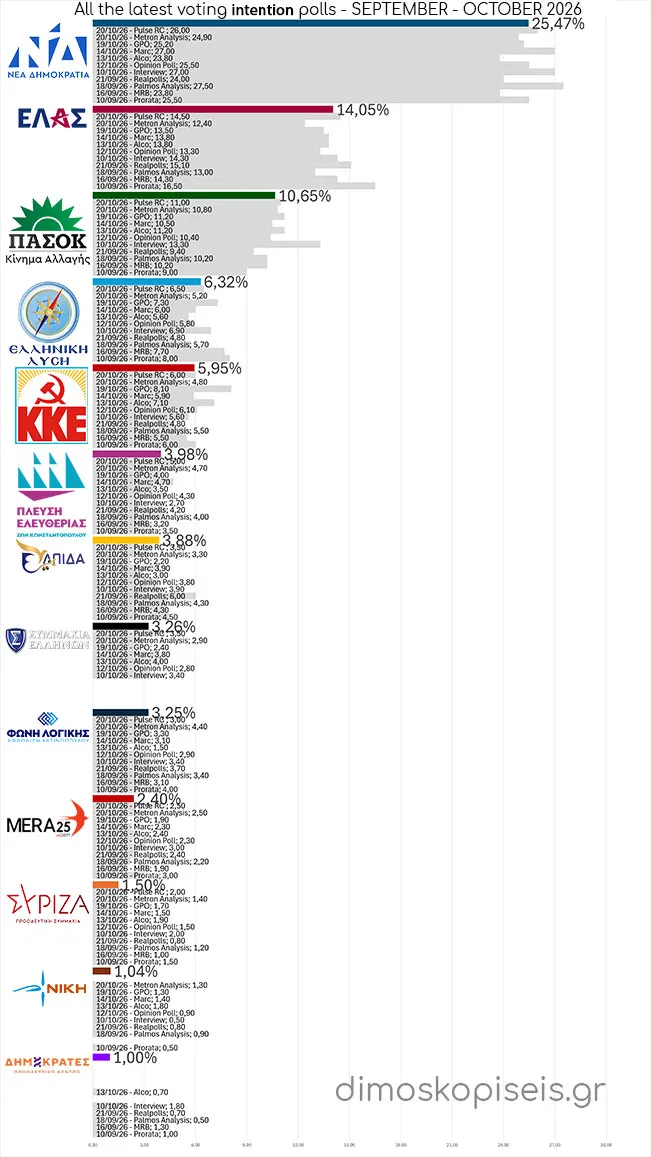
The anticipated September polling “deluge” materialised. Thirteen surveys by eleven different polling companies were published during the month. The average is calculated using the eleven most recent surveys—one per company—so that no company receives greater weight simply because it published a second survey within the same month. This broader base provides a considerably more comprehensive picture of the political balance than periods of limited polling activity.
September’s political agenda was dominated by the 90th Thessaloniki International Fair and the presentation of economic proposals by the government and opposition parties. Meanwhile, Parliament held the second vote on constitutional revision. In foreign policy, Greek–Turkish relations, defence procurement, marine parks and the prime minister’s attendance at the UN General Assembly took centre stage. The OPEKEPE affair also continued to fuel political confrontation, keeping transparency and corruption high on the agenda.
September 2026’s Winners and Losers
September’s biggest polling winner is PASOK, which gains 0.98 percentage points, rising from 9.47% to 10.45% in voting intention. This represents a relative increase of 10.35%, allowing the party to narrow its gap considerably with second-placed EL.A.S. The voting-intention gap falls from 5.39 to 3.74 percentage points.
Voice of Reason also records a significant increase, gaining 0.27 percentage points, or 8.91%, to reach 3.30%. This performance represents more than a numerical improvement: it substantially strengthens the party’s prospects of parliamentary representation.
Course of Freedom also moves upwards, gaining 0.13 percentage points, or 3.32%, to reach 4.04%.
New Democracy records an identical increase in percentage points, edging up from 25.56% to 25.69%, a relative change of just 0.51%. This rise points more to the governing party’s stabilisation than to strong new momentum following the Thessaloniki International Fair.
At the other end of the scale, September’s biggest loser is once again Hope for Democracy. The party falls from 6.54% to 4.24%, losing 2.30 percentage points, or 35.17% of its previous polling support. This is its third consecutive period of significant decline, raising further questions about the actual size of its stable electoral base.
Greek Solution also records substantial losses, falling by 0.65 percentage points, or 8.82%, to 6.72%. Despite this decline, it retains fourth place and remains the strongest political force to the right of New Democracy.
EL.A.S. loses 0.67 percentage points, or 4.51%, falling to 14.19%. This decline does not immediately threaten its second-place position, but it reduces its lead over a rising PASOK and interrupts the upward trajectory recorded during the first months of its presence.
KKE also moves downwards, losing 0.41 percentage points, or 6.57%, to stand at 5.83%. Despite this decline, it rises to fifth place in the rankings, owing to Hope for Democracy’s much sharper fall.
The decline of Democrats – Progressive Centre is particularly significant: the party loses 0.31 percentage points, or 25.20%, falling to 0.92%. Smaller losses are recorded by SYRIZA, down 0.13 percentage points, or 8.28%; MeRA25, down 0.05 percentage points, or 1.97%; and NIKI, which edges down by 0.02 percentage points, or 2.04%.
The New Balance of Political Forces
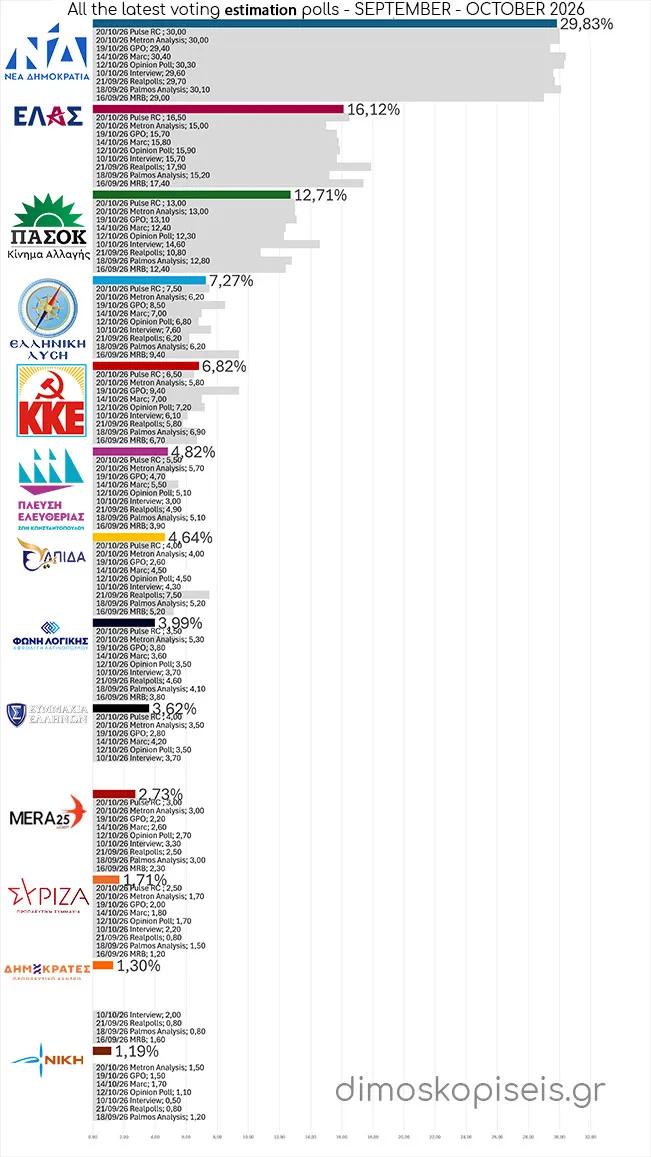
First place in the political landscape remains undisputed. New Democracy stands at 25.69% in voting intention and 30.16% after adjustment for undecided voters. Its lead over second-placed EL.A.S. amounts to 11.50 percentage points in voting intention and 13.89 percentage points after adjustment.
Despite maintaining its dominance, New Democracy has yet to demonstrate the momentum needed to approach an outright parliamentary majority. Surveys conducted during and after the Thessaloniki International Fair show only a marginal increase in its average support. There is therefore no clear polling boost capable of triggering a broader shift of voters towards the governing party.
EL.A.S. remains in second place with 14.19% in voting intention and 16.27% after adjustment. Its decline, combined with PASOK’s rise, significantly narrows the gap between them. From 5.39 percentage points in the July–August period, the gap now falls to 3.74 percentage points. The picture is similar after adjustment: the distance between EL.A.S. and PASOK narrows from 5.74 to 3.90 percentage points. Second place is not under immediate threat, but if the two parties’ opposing trends continue, their contest could become one of the most important political and polling developments of the coming months.
PASOK consolidates third place with 10.45% in voting intention and 12.37% after adjustment. For the first time since the emergence of the new political formations, it records a strong upward shift and begins to bring the contest for second place back to the political forefront. The key question is whether September’s rise represents a lasting trend or a temporary effect of the party’s increased visibility at the Thessaloniki International Fair.
Greek Solution remains in fourth place with 6.72%, despite its significant decline. KKE moves up to fifth place with 5.83%, while Hope for Democracy falls to sixth with 4.24%. The gap between them now stands at 1.59 percentage points.
Course of Freedom follows in seventh place with 4.04%, just 0.20 percentage points behind Hope for Democracy. This narrow gap suggests that sixth place remains open and could change hands as early as the next round of polls.
Voice of Reason completes the group of eight parties currently above the threshold for parliamentary representation. With 3.30% in voting intention and 4% after adjustment, it establishes a clearer margin above the 3% threshold and strengthens its position in the hypothetical seat allocation. This does not, however, mean that its entry into Parliament can already be taken for granted.
MeRA25 remains the highest-polling party projected to stay outside Parliament, with 2.49% in voting intention and 2.77% after adjustment. Its distance from the electoral threshold is small, keeping the possibility of a nine-party Parliament open. It is followed by SYRIZA with 1.44%, NIKI with 0.96% and Democrats – Progressive Centre with 0.92%.
Hypothetical Seat Allocation
Based on the September 2026 polling average after adjustment for undecided voters, an eight-party Parliament remains the projected scenario.
New Democracy emerges stronger, but still falls short of the required majority of 151 seats. It secures 123 seats, leaving it 28 seats short of an outright majority and making a coalition government necessary.
The hypothetical allocation of the 300 seats is as follows:
- New Democracy: 123 seats, up four.
- EL.A.S.: 50 seats, down two.
- PASOK: 38 seats, up four.
- Greek Solution: 24 seats, down one.
- KKE: 21 seats, down one.
- Hope for Democracy: 16 seats, down eight.
- Course of Freedom: 15 seats, up one.
- Voice of Reason: 13 seats, up three.
Compared with the July–August period, the most significant parliamentary changes are Hope for Democracy’s loss of eight seats and the gains of four seats each for New Democracy and PASOK. Voice of Reason also gains three seats, confirming that its rise now has a meaningful impact on projected parliamentary representation.
A single-party majority government remains out of reach on current polling figures. Arithmetically, a rather unlikely coalition between New Democracy and PASOK would command 161 seats, while most other possible governing arrangements would require broader and politically more difficult partnerships.
September’s More Comprehensive Polling Base
September is one of the most comprehensively polled months of 2026. A total of thirteen polls from eleven different companies were published, compared with nine surveys from seven companies across the entire July–August period. However, only each company’s most recent survey is included in the average.
One survey—Interview’s first poll, which is excluded from the average—was conducted before the Thessaloniki International Fair. Two surveys were conducted during the political leaders’ appearances at the fair, and the remaining ten after those appearances had concluded.
Eleven polls, one from each company, were used to calculate the voting-intention average. Of the thirteen published surveys, Interview’s first poll, conducted from 26 August to 1 September, and GPO’s first poll for Star were excluded, as both companies published a more recent survey within the same month. Nine of the eleven surveys were included in the average adjusted for undecided voters, as ALCO and Prorata did not publish a corresponding adjustment.
September’s main political conclusion is that New Democracy’s lead remains secure, but an outright majority is still a distant prospect. At the same time, EL.A.S.’s decline and PASOK’s rise reopen the contest for second place, while among the mid-ranking parties, Hope for Democracy’s sharp fall and Voice of Reason’s gains create a new and more fluid balance of forces.
Three Years of Tracking Opinion Polls
September 2026 marked three years of systematic opinion-poll tracking. The large volume of data collected during this period has enabled us to study differences between polling companies in the support they record for each party, as well as the role played by their different methodologies. Read the related article

New Democracy is a liberal-conservative political party in Greece. In contemporary Greek politics, New Democracy has been the main centre-right to right wing political party and one of the two major parties.
PARLIAMENTARY ELECTIONS 2023: 40.56% 158 SEATS
EURO ELECTIONS 2024: 28.31% 7 SEATS
CURRENT STRENGTH: 155 Parliamentary Seats (Government)
New Democracy LATEST POLLS
Marginal Gains and a Secure Lead, but an Outright Majority Remains Far Off
New Democracy maintained its dominance of the political landscape in September 2026, recording a marginal improvement in its polling performance. Its lead remains secure, and the gap with second-placed EL.A.S. widens. However, it has yet to demonstrate the momentum needed to put the governing party firmly back on course for an outright parliamentary majority.
In voting intention, New Democracy’s average stands at 25.69%, compared with 25.56% in the July–August period. The increase amounts to just 0.13 percentage points, or 0.51%, pointing more to the stabilisation of its electoral support than to the emergence of a new upward trend.
After adjustment for undecided voters, its average rises to 30.16%, from 29.84% in the previous two-month period. This increase of 0.32 percentage points allows New Democracy to edge back above 30%, without substantially altering the overall political picture.
Its adjusted figure of 30.16% is 1.85 percentage points higher than the 28.31% it received in the 2024 European Parliament elections, but remains 10.40 percentage points below its 40.56% result in the 2023 general election. This comparison shows that New Democracy has recovered some of the ground lost in the European elections, but remains well below the level achieved in the last national contest.
Its dominance is also clearly reflected in its lead over second-placed EL.A.S. In voting intention, the gap between the two parties stands at 11.50 percentage points, up from 10.70 in the previous two-month period. After adjustment, the gap widens to 13.89 percentage points, compared with 12.76 in July–August. New Democracy’s gains, combined with EL.A.S.’s decline, make its first-place position even more secure.
The governing party’s main challenge remains its distance from an outright majority. In the hypothetical seat allocation, New Democracy secures 123 seats, four more than in the previous two-month period, but still falls 28 seats short of the required majority of 151. Even with September’s more favourable picture, forming a single-party majority government is not currently a realistic scenario.
The month’s political agenda was dominated by the Thessaloniki International Fair and the presentation of the government’s economic proposals. Polls conducted during and after the fair record only a marginal increase in New Democracy’s average support. So far, therefore, there is no clear polling boost capable of prompting a broader return of voters to the governing party.
Meanwhile, the OPEKEPE affair continued to keep transparency and corruption high on the political agenda. Constitutional revision, defence procurement, Greek–Turkish relations and the prime minister’s attendance at the UN General Assembly, however, allowed the government to highlight its agenda on institutional reform, foreign policy and national security.
Developments to the right of New Democracy also continue to warrant attention. Despite Greek Solution’s decline in September, the party remains in fourth place, while Voice of Reason’s rise indicates that part of the conservative electorate continues to seek alternatives. The possibility of Antonis Samaras establishing a new political party also remains a potential source of pressure, particularly on New Democracy’s prospects of securing an outright majority.
On current figures, New Democracy has established a strong lead in the contest for first place, but lacks the support needed to govern with an outright majority. September’s picture is one of resilient stability around 30%, rather than a substantial electoral recovery.
The crucial question for the coming months is whether the governing party can break through this polling “ceiling” and broaden its appeal beyond its current electoral base. Otherwise, however secure its lead remains, discussion of post-election coalitions will intensify as the 2027 general election approaches.
SEPTEMBER 2026

The Greek Left Alliance (EL.A.S.) is a Greek political party, founded on 28 May 2026 by former Prime Minister Alexis Tsipras. The party defines itself as the “governing left”, stating that it expresses the three historical currents of the left: social democracy, radical left and political ecology.
EP affiliation: ?
New party
CURRENT STRENGTH: 0 Parliamentary Seats
EL.A.S. LATEST POLLS
Still in Second Place, but Its Rise Stalls as PASOK Closes In
The Greek Left Alliance retains second place in the political landscape in September 2026, but records its first clear decline following an initial period of impressive gains and stabilisation. This development does not immediately challenge its role as a principal opposition force, but it reduces its lead over PASOK and makes the prospect of closing the gap with New Democracy even more distant.
In voting intention, EL.A.S.’s average stands at 14.19%, compared with 14.86% in the July–August period. This decline of 0.67 percentage points represents a relative decrease of 4.51%, interrupting the upward trajectory recorded during the first months of the party’s presence.
The picture is similar after adjustment for undecided voters. Its average falls to 16.27%, from 17.08% in the previous two-month period, a loss of 0.81 percentage points, or 4.74%. The simultaneous decline in both voting intention and the adjusted figures suggests that this is more than a technical variation between measurements: it marks the first meaningful slowdown in the party’s polling momentum.
The gap with New Democracy widens considerably. In voting intention, it increases to 11.50 percentage points, from 10.70 in the previous two-month period, while after adjustment it reaches 13.89 percentage points, compared with 12.76. Rather than the two parties moving closer together, New Democracy is extending its lead once again.
By contrast, EL.A.S.’s lead over PASOK narrows significantly. In voting intention, it falls from 5.39 to 3.74 percentage points, while after adjustment it shrinks from 5.74 to 3.90 percentage points. Second place is not under immediate threat, but EL.A.S.’s decline alongside PASOK’s strong gains brings their contest back into focus. If these opposing trends continue, the battle for second place could become one of the most important political developments of the coming months.
This shift is also reflected in the hypothetical seat allocation. EL.A.S. secures 50 seats, two fewer than in July–August, while PASOK rises to 38. Its 12-seat lead remains significant and would make EL.A.S. the official opposition, but it is considerably smaller than the 18-seat gap recorded in the previous period.
SYRIZA’s continuing crisis still provides EL.A.S. with political and organisational space across the broader left and centre-left. However, September’s decline suggests that voters’ shift towards the new formation is no longer an automatic process. EL.A.S. must now compete with a stronger PASOK and persuade voters beyond Alexis Tsipras’s traditional support base.
The party’s greatest advantage remains the former prime minister’s name recognition and experience in government. These qualities allow EL.A.S. to position itself from the outset as an alternative governing force. At the same time, however, the 2015–2019 period remains a reference point for voters who view SYRIZA’s previous government negatively, potentially limiting the party’s scope to broaden its appeal further.
The party’s political presence during the Thessaloniki International Fair does not appear to have generated an immediate polling boost. Increased visibility and the presentation of its proposals were not accompanied by improved polling figures. This does not necessarily mean that its interventions were received negatively, but it suggests that translating public visibility into fresh electoral momentum is a more difficult undertaking than establishing an initial political presence.
The central challenge remains the development of a distinct political identity. EL.A.S. must demonstrate that it is more than a reconfigured SYRIZA: a new political force with a coherent programme for government, a renewed team of party officials and an organisational presence throughout the country. The selection of party figures, the formation of candidate lists and the development of local branches will determine whether it can broaden its influence without importing the internal conflicts that weakened SYRIZA. You can follow regular updates on EL.A.S.’s activities and positions at ekloges2027.com
On current figures, EL.A.S. remains New Democracy’s main rival in the polls and the party most likely to become the next official opposition. September’s decline, however, confirms that its initial period of easy and rapid gains has come to an end.
The crucial question for the coming months is whether this decline represents a temporary correction or the beginning of a more lasting stabilisation at lower levels. To move from a strong second-place party to a credible alternative government, EL.A.S. must now both defend its lead over PASOK and generate the fresh political momentum needed to narrow the gap with New Democracy.
SEPTEMBER 2026

The Panhellenic Socialist Movement, known mostly by its acronym PASOK, is a social-democratic political party in Greece. Until 2012 it was one of the two major parties in the country. After a decade of poor electoral outcomes, PASOK has retained its position as one of the main Greek political parties and is currently the second largest party in the Greek Parliament.
PARLIAMENTARY ELECTIONS 2023: 11.84% 31 SEATS
EURO ELECTIONS 2024: 12.79% 3 SEATS
CURRENT STRENGTH: 33 Parliamentary Seats (Official Opposition)
PASOK LATEST POLLS
Holding Steady in Third Place, but Lacking the Momentum to Reclaim Second
PASOK retained third place in the political landscape throughout July and August 2026, confirming the polling stabilisation that had begun to emerge in June. The sharp decline caused by the appearance of new political formations appears to have been halted, although no meaningful recovery has yet been recorded.
The emerging picture is that of a party that has secured its place among the top three but continues to poll below the levels it achieved in the two most recent elections. PASOK is not under any immediate threat of losing third place, but neither does it display the momentum required to close the gap with EL.A.S. and reclaim its role as the official opposition.
In voting intention, the party’s average stands at 9.47%, compared with approximately 9.69% in June. This represents a decline of 0.22 percentage points, or 2.27%. The individual poll results vary relatively widely, ranging from 8.5% to 10%, indicating that PASOK’s electoral base has not yet fully stabilised at a specific level.
The picture is more stable after the reallocation of undecided voters. The average of the available July polls stands at 11.34%, compared with 11.38% in June. The difference is limited to just 0.04 percentage points, effectively placing the party within the bounds of complete polling stagnation.
The individual adjusted results range from 10.8% to 12.3%. This range reflects PASOK’s inability to establish a consistent upward trend, but also its resilience against another potentially sharp decline.
As with the analyses of the other parties, it should be noted that the voting-intention and adjusted averages are not based on exactly the same set of surveys. Moreover, only one new voting-intention poll was conducted during August. The small changes recorded over the two-month period should therefore be viewed more as evidence of stabilisation than as confirmation of a shift in the electoral trend.
The adjusted figure of 11.34% remains 0.50 percentage points below the 11.84% PASOK secured in the 2023 national election and 1.45 points below its 12.79% result in the 2024 European elections. PASOK has not only failed to return to its previous electoral levels but continues to poll consistently below them, despite the government’s significant decline in support and SYRIZA’s weakening.
This is perhaps the party’s greatest political weakness, particularly at a time when New Democracy is polling approximately 10.7 percentage points below its result in the 2023 national election.
The emergence of EL.A.S. has overturned the core strategy developed at PASOK’s headquarters on Charilaou Trikoupi Street. In voting intention, PASOK now trails Alexis Tsipras’s party by 5.39 percentage points, while the gap widens to 5.74 points after the reallocation of undecided voters. This difference cannot be closed solely through marginal voter shifts or the organisational mobilisation of the party’s existing electoral base.
At the same time, third place should not be considered entirely secure in the longer term. In voting intention, PASOK’s lead over the rising Greek Solution has narrowed to 2.10 percentage points. After the reallocation of undecided voters, the gap widens to 2.92 points, but remains at a level that leaves no room for complacency if the two parties continue moving in opposite directions.
By contrast, the significant decline of Hope for Democracy has reduced one of the immediate threats facing PASOK. Maria Karystianou’s party has fallen to fifth place, allowing PASOK to maintain a wider lead over the other parties behind it. Stabilisation in third place, however, is not enough in itself to put PASOK back on a path towards challenging for power.
The hypothetical seat distribution clearly illustrates the party’s current position. PASOK would secure approximately 34 seats, one fewer than in June. It trails EL.A.S., which holds 52 seats, by 18, but remains nine seats ahead of Greek Solution and ten ahead of Hope for Democracy.
These 34 seats increase PASOK’s significance in post-election scenarios. Combined with New Democracy’s 119 seats, the two parties could numerically form a majority of 153 MPs. Although PASOK’s leadership and party congress have rejected the possibility of cooperation with New Democracy, the parliamentary balance inevitably keeps the party at the centre of discussions about the formation of the next government.
This situation presents both an opportunity and a risk. On the one hand, PASOK remains essential to several possible coalition scenarios. On the other, it risks being perceived more as a supplementary coalition partner than as a credible governing force in its own right. If this perception becomes entrenched, attracting voters seeking a genuine alternative to New Democracy will become even more difficult.
During the summer, PASOK sought to strengthen its policy profile. It presented 17 commitments for pensioners, followed by 11 measures addressing private debt and the protection of borrowers. At the same time, it highlighted issues such as the cost of living, the housing crisis, energy costs, the functioning of the state and the use of resources from the Recovery and Resilience Fund. Continuous coverage of PASOK’s activities and positions is available on Ekloges 2027.
This strategy is moving in the right direction, as PASOK needs specific and fully costed proposals to strengthen its governing credibility. So far, however, these initiatives have not translated into measurable gains in the polls. The party continues to face a political communication problem and struggles to turn its policy positions into a clear and appealing political narrative.
The central strategic dilemma remains the same as it was in June, but is becoming increasingly pressing. PASOK must decide whether its main opponent is New Democracy, from which it seeks to attract moderate centrist voters, or EL.A.S., from which it must reclaim second place and leadership of the centre-left.
Focusing exclusively on New Democracy strengthens PASOK’s profile as a party seeking to become an alternative government, but leaves EL.A.S. in the role of the principal opposition force. Conversely, a head-on confrontation with Alexis Tsipras could help differentiate the two parties, but carries the risk of trapping PASOK in an internal contest within the centre-left while leaving New Democracy outside the main arena of political confrontation.
The Thessaloniki International Fair therefore represents a crucial opportunity for a political relaunch. Nikos Androulakis must present a coherent programme for government, clarify the party’s position towards both New Democracy and EL.A.S., and convince voters that PASOK is not confined to the role of kingmaker in post-election developments.
Based on the current data, PASOK has stabilised in third place but has not regained the political initiative. It does not face an immediate risk of another major decline in the polls, but remains stuck at around 10% in voting intention and slightly above 11% after the reallocation of undecided voters.
The critical question for the autumn is no longer whether PASOK will remain one of the country’s most important political players, but whether it can escape the role of the permanently third-placed party. Without a clear political identity, a stronger governing narrative and a broader social base, it risks entering the 2027 election as an indispensable coalition partner rather than as an independent contender for power.
SEPTEMBER 2026

The Greek Solution is a political party in Greece founded by Kyriakos Velopoulos. The party is right-wing to far-right and has been described as ideologically ultranationalist, national conservative.
PARLIAMENTARY ELECTIONS 2023: 4.44% 12 SEATS
EURO ELECTIONS 2024: 9.25% 2 SEATS
CURRENT STRENGTH: 11 Parliamentary Seats (5th party)
Greek Solution LATEST POLLS
A Decline After the Summer Gains, but a Firmer Hold on Fourth Place
Greek Solution records a notable polling decline in September 2026, interrupting the strong upward trajectory of previous months. Despite these losses, Kyriakos Velopoulos’s party retains and consolidates fourth place, mainly because of Hope for Democracy’s much sharper fall.
In voting intention, Greek Solution’s average stands at 6.72%, compared with 7.37% in the July–August period. This decline of 0.65 percentage points represents a relative decrease of 8.82% and is one of September’s most significant negative changes.
The picture is similar after adjustment for undecided voters. Its average falls to 7.69%, from 8.42% in the previous two-month period, a loss of 0.73 percentage points, or approximately 8.67%. The shared downward direction of both indicators suggests that the decline is more than a result of the different mix of surveys.
Compared with the most recent elections, Greek Solution remains in a considerably stronger position than in the 2023 general election. Its adjusted figure of 7.69% is 3.25 percentage points above the 4.44% it received then. However, it remains 1.61 percentage points below its 9.30% result in the 2024 European Parliament elections.
Despite the decline, the party’s hold on fourth place now appears more firmly established. Greek Solution leads Hope for Democracy by 2.48 percentage points in voting intention and 2.55 percentage points after adjustment. This gap is considerably larger than in the previous two-month period, owing to Hope for Democracy’s much greater losses rather than an increase in Greek Solution’s support.
At the same time, however, the prospect of an immediate challenge for third place recedes. The gap with PASOK increases to 3.73 percentage points in voting intention, from 2.10 in the previous two-month period. After adjustment, it widens to 4.68 percentage points, compared with 2.92. PASOK’s strong gains alongside Greek Solution’s decline interrupt, at least temporarily, discussion of a possible reversal in third place.
Its contest with KKE is becoming more competitive. Greek Solution leads by 0.89 percentage points in voting intention and 0.87 percentage points after adjustment. If current trends continue, the battle for fourth place could shift from competition with Hope for Democracy to a contest with KKE.
This change is also reflected in the hypothetical seat allocation. Greek Solution secures 24 seats, one fewer than in July–August. It leads KKE, which secures 21 seats, by three, and Hope for Democracy, which falls to 16 seats, by eight. By contrast, its gap with PASOK increases to 14 seats.
September’s decline does not alter the fact that Greek Solution has a strong and identifiable electoral base. Its position as the most significant political force to the right of New Democracy remains secure, while its polling figures are still substantially higher than its result in the 2023 general election.
The month’s political agenda included issues on which the party has a distinct position, such as Greek–Turkish relations, defence procurement, immigration, the cost of living and the functioning of the state. However, the increased prominence of these issues did not translate into further polling gains. Finally, the party’s absence from the Thessaloniki International Fair may have contributed to some extent to its downward trend during the month.
Kyriakos Velopoulos’s high name recognition, the party’s consistent political rhetoric and its strong presence in the media and on social networks remain important advantages. These factors strengthen the cohesion of its electoral base and allow Greek Solution to maintain a clear identity in a highly fragmented political landscape. You can follow regular updates on its activities and positions at Elections 2027.
However, the party’s strong dependence on its leader may limit its future growth. To return to the levels achieved in the European elections, Greek Solution needs more recognisable party figures, a stronger organisational presence across electoral constituencies and a more comprehensive programme for government that extends beyond the protest vote.
Meanwhile, Voice of Reason’s rise indicates that competition for the broader right-wing and conservative vote remains intense. Adding to this is the possibility of Antonis Samaras establishing a new political party, which could appeal to part of the same electorate and further restrict Greek Solution’s scope for growth.
On current figures, Greek Solution remains one of the most significant players among the mid-ranking parties and retains secure prospects of parliamentary representation. Its hold on fourth place is now stronger, but the prospect of closing the gap with PASOK is becoming more distant.
The crucial question for the coming months is whether September’s decline represents a temporary correction following the substantial summer gains or the beginning of a new period of falling support. The answer will determine whether Greek Solution focuses on retaining fourth place or can return to polling levels close to its 2024 European Parliament election result.
SEPTEMBER 2026

The Communist Party of Greece is a Marxist–Leninist political party in Greece. It was founded in 1918 as the Socialist Workers’ Party of Greece (SEKE) and adopted its current name in November 1924. It is the oldest political party in modern Greek politics.
PARLIAMENTARY ELECTIONS 2023: 7.69% 21 SEATS
EURO ELECTIONS 2024: 9.25% 2 SEATS
CURRENT STRENGTH: 21 Parliamentary Seats (4th party)
KKE LATEST POLLS
Declining Support, but a Rise to Fifth Place
KKE records a polling decline in September 2026, interrupting the improvement seen during the July–August period. Despite these losses, it moves from sixth to fifth place in the rankings, owing to Hope for Democracy’s much sharper fall.
In voting intention, KKE’s average stands at 5.83%, compared with 6.24% in the previous two-month period. This decrease of 0.41 percentage points represents a relative decline of 6.57%, taking the party back below 6%.
The decline is smaller after adjustment for undecided voters. Its average falls to 6.82%, from 7.12% in July–August, a loss of 0.30 percentage points, or 4.21%. Although this decline is milder, the shared direction of both indicators confirms that the summer rebound did not continue into September.
Its adjusted figure of 6.82% remains 0.87 percentage points below the 7.69% it received in the 2023 general election. The gap with its 2024 European Parliament election result is larger: KKE stands 2.43 percentage points below the 9.25% it secured then. Recovering its electoral performance of 2023–2024 therefore remains a demanding goal.
Despite its declining support, KKE rises to fifth place. In voting intention, it now leads Hope for Democracy by 1.59 percentage points, while after adjustment the gap stands at 1.68 percentage points. This change in the rankings reflects the much sharper decline of Maria Karystianou’s party rather than an increase in KKE’s support.
The gap with fourth-placed Greek Solution remains narrow. KKE trails by 0.89 percentage points in voting intention and 0.87 percentage points after adjustment. The simultaneous decline of both parties keeps the contest for fourth place open, although there is currently no clear momentum towards a reversal of their positions.
Its lead over Course of Freedom is more secure. The gap between them amounts to 1.79 percentage points in voting intention and 1.95 percentage points after adjustment. KKE therefore remains in the upper tier of the mid-ranking parties, with its parliamentary representation considered fully secure.
The new picture is also reflected in the hypothetical seat allocation. KKE secures 21 seats, one fewer than in the previous two-month period. It trails Greek Solution by three seats, but leads Hope for Democracy by five and Course of Freedom by six.
September’s decline does not negate the party’s long-standing resilience. Its clear ideological identity, organisational cohesion and consistent rejection of coalition governments protect KKE from the sharp realignments affecting the other parties of the left. Despite EL.A.S.’s strong presence, there is no sign of a breakdown in its core electoral base.
The main challenge remains broadening its appeal beyond that base. KKE maintains a steady presence in trade unions, labour protests and social struggles, but finds it difficult to translate this activity into lasting electoral gains. September’s decline suggests that public discontent does not automatically translate into support for the party.
The economic and social agenda continues to provide favourable ground for political engagement. The cost of living, wages, the housing crisis, employment relations and the state of public services allow KKE to articulate its distinct criticism of both the government and the parties seeking to present themselves as alternative governing forces.
Similarly, defence procurement, cooperation with Israel and wider geopolitical tensions give KKE greater scope to highlight its long-standing opposition to Greece’s involvement in NATO and European Union strategies. This position continues to distinguish it clearly from most political forces. You can follow regular updates on the party’s activities and positions on the KKE page at ekloges2027.com
Its presence at the Thessaloniki International Fair and the accompanying protests was not followed by a rise in the polls. This confirms that political and protest activity alone is insufficient to attract voters moving away from SYRIZA, Course of Freedom or other protest-oriented political formations.
On current figures, KKE comfortably retains its projected parliamentary representation and rises to fifth place despite its declining support. Its ranking improves, but its electoral support remains below the levels achieved in the two most recent elections.
The crucial question for the coming months is whether September’s decline represents a temporary correction or a return to a lower polling level around 6%. The answer will determine whether KKE can challenge Greek Solution for fourth place or focus on maintaining its lead over Hope for Democracy and Course of Freedom.
SEPTEMBER 2026

Hope for Democracy is a political movement in Greece, founded by pediatrician Maria Karystianou. The movement presents itself as multidisciplinary with its main axes being the demand for justice and anti-corruption.
EP affiliation: ?
New party
CURRENT STRENGTH: 0 Parliamentary Seats
Hope for Democracy LATEST POLLS
Another Sharp Fall, a Drop to Sixth Place and Pressure from Course of Freedom
Hope for Democracy records its third consecutive—and steepest—polling decline in September 2026. Maria Karystianou’s party fails to halt the downward trajectory that began after its impressive debut, falls from fifth to sixth place and now stands only marginally ahead of Course of Freedom.
In voting intention, Hope for Democracy’s average stands at 4.24%, compared with 6.54% in the July–August period. This loss of 2.30 percentage points represents a relative decline of 35.17% and is by far the largest negative change recorded by any party in September.
The picture is similar after adjustment for undecided voters. Its average falls to 5.14%, from 7.82% in the previous two-month period, a loss of 2.68 percentage points, or 34.27%. The almost identical relative decline in both indicators confirms that this is more than a technical variation between measurements: it represents a substantial contraction in the party’s polling support.
Despite the sharp decline, its average remains above the 3% electoral threshold. Parliamentary representation remains the most likely scenario, but can no longer be considered as secure as it was during the party’s first months. Another decline of similar magnitude could put its entry into Parliament at immediate risk.
The shift in the balance among the mid-ranking parties is particularly pronounced. Hope for Democracy now trails Greek Solution by 2.48 percentage points and KKE by 1.59 percentage points in voting intention. After adjustment, the corresponding gaps stand at 2.55 and 1.68 percentage points.
At the same time, its lead over Course of Freedom narrows to just 0.20 percentage points in voting intention and 0.27 percentage points after adjustment. Sixth place therefore remains wide open and could change hands even with small shifts in the next polls.
This deterioration is also reflected in the hypothetical seat allocation. Hope for Democracy secures 16 seats, eight fewer than in July–August. It trails Greek Solution by eight seats and KKE by five, while holding a lead of just one seat over Course of Freedom.
Sixteen seats would still represent a notable parliamentary presence for a newly established party. However, losing one-third of its projected parliamentary representation within a single polling period illustrates its considerable volatility and the absence of a fully consolidated electoral base.
Hope for Democracy’s initial momentum relied heavily on Maria Karystianou’s personal appeal and her association with demands for justice, transparency and accountability. These remain the party’s most important political assets, but are not sufficient on their own to sustain the very high levels of support recorded during its initial emergence.
As the election approaches, voters are seeking clearer positions on the economy, the cost of living, housing, healthcare, education, foreign policy and the functioning of the state. The limited publicity given to the party’s comprehensive and costed programme may be making it harder to translate initial public support into a stable electoral choice.
Building the party’s organisation is equally critical. Recruiting party officials, developing local branches, selecting candidates and bringing more recognisable figures to the forefront are essential to reducing its dependence on its founder’s personal presence. You can follow regular updates on Hope for Democracy’s activities and positions at ekloges2027.com.
The party must also establish a clearer position on the political map. Its initial broad appeal brought together voters from different political backgrounds around the demand for institutional change. Developing a distinct ideological identity and policy platform could strengthen its credibility, but may also alienate sections of this diverse support base.
Competition for protest and anti-establishment votes remains intense. There is insufficient evidence of voter movements to identify which parties are attracting those who withdraw their support. It is clear, however, that Hope for Democracy now faces pressure from KKE and Greek Solution, as well as Course of Freedom, whose polling figures are very close to its own.
On current figures, Hope for Democracy remains a significant force in the projected Parliament, but has lost the momentum that once allowed it to challenge even for third place. Political discussion is now shifting from its prospects of leading the group of mid-ranking parties to its ability to establish itself securely above 3%.
The crucial question for the coming months is whether 4.24% represents a new polling “floor” or merely another stage in a continuing decline. The presentation of a comprehensive programme, the recruitment of party officials and organisational development will determine whether the party can recover some of its initial momentum or enter the 2027 election fighting to secure its parliamentary representation.
SEPTEMBER 2026

Course of Freedom is a Greek left-wing political party founded in 2016 by the former President of the Hellenic Parliament, Zoe Konstantopoulou.
PARLIAMENTARY ELECTIONS 2023: 3.17% 8 SEATS
EURO ELECTIONS 2024: 3.40% 1 SEAT
CURRENT STRENGTH: 8 Parliamentary Seats (8th party)
Course of Freedom LATEST POLLS
Small but Clear Gains and a Renewed Challenge for Sixth Place
Course of Freedom records a further polling improvement in September 2026, confirming that the sharp decline of previous months has, at least temporarily, been halted. Its gains remain modest, but are particularly significant because they coincide with Hope for Democracy’s steep fall, bringing the two parties within just 0.20 percentage points of each other.
In voting intention, Course of Freedom’s average stands at 4.04%, compared with 3.91% in the July–August period. This increase of 0.13 percentage points represents a relative gain of 3.32%, allowing the party to return above 4%.
The picture is more positive after adjustment for undecided voters. Its average rises to 4.87%, from 4.62% in the previous two-month period, an increase of 0.25 percentage points, or 5.41%. The shared upward direction of both indicators supports the view that Course of Freedom is developing a more stable electoral base.
September’s rise also suggests that the low figure of 2.9% recorded by Interview in late August did not mark the beginning of another broad decline. That result should not be disregarded, as it illustrates the variability of individual polls, but September’s average, based on a broader set of surveys, places Course of Freedom at a safer distance from the 3% threshold.
Compared with the most recent elections, the party continues to stand at considerably higher levels. Its adjusted figure of 4.87% is 1.47 percentage points above its 3.40% result in the 2024 European Parliament elections and 1.70 percentage points above the 3.17% it received in the 2023 general election.
The current picture is, of course, still far removed from the double-digit polling figures Course of Freedom recorded at the peak of its rise. Despite the substantial decline from those levels, the party appears to have retained a meaningful share of the gains achieved since the 2023 election.
In the rankings, Course of Freedom remains in seventh place, but closes dramatically on sixth-placed Hope for Democracy. It trails by just 0.20 percentage points in voting intention, while after adjustment the gap narrows to 0.27 percentage points. Even small changes in the next polls could reverse their positions.
The gap with KKE remains larger. Course of Freedom trails by 1.79 percentage points in voting intention and 1.95 percentage points after adjustment. A challenge for fifth place is not yet an immediate prospect, but the gap is smaller than in the previous two-month period.
Meanwhile, its lead over Voice of Reason narrows to 0.74 percentage points in voting intention and 0.87 percentage points after adjustment. Course of Freedom therefore sits at the centre of a highly competitive group, in which sixth to eighth place could change hands even with relatively small shifts in voter support.
The improvement is also reflected in the hypothetical seat allocation. Course of Freedom secures 15 seats, one more than in the previous two-month period. It trails Hope for Democracy by just one seat and leads Voice of Reason by two. Fifteen seats would give the party a significant parliamentary presence, without granting it a decisive role in possible scenarios for forming a government.
Course of Freedom’s strongest political asset remains Zoe Konstantopoulou’s personal presence. Her vigorous parliamentary activity and focus on justice, transparency, institutional accountability and the protection of rights give the party a clear and recognisable political identity.
However, the party’s dependence on its leader also limits its scope for future growth. Bringing more party figures to the forefront, strengthening its presence across electoral constituencies and presenting comprehensive proposals on the economy, social policy, healthcare and foreign policy are essential to translating its leader’s personal appeal into a more firmly established party identity. You can follow regular updates on Course of Freedom’s activities and positions at ekloges2027.com.
Competition for protest and progressive votes remains particularly intense. Hope for Democracy’s sharp decline was not mirrored by equivalent gains for Course of Freedom, but it allowed the latter to close almost the entire gap between them. Without detailed evidence of voter movements, it is impossible to establish with confidence where the remaining voters withdrawing support from Maria Karystianou’s party are turning.
Meanwhile, EL.A.S.’s presence as a principal opposition force limits Course of Freedom’s prospects of returning to the very high polling levels of previous months. Zoe Konstantopoulou’s party now appears to be establishing itself more as a forceful institutional and parliamentary opposition than as an immediate alternative governing force.
On current figures, Course of Freedom remains above the electoral threshold and strengthens its prospects of retaining parliamentary representation. Its gains are small, but continue the stabilisation that began in June and renew its challenge for sixth place.
The crucial question for the coming months is whether the party can consolidate its support around 4%–5% and overtake Hope for Democracy, or whether the considerable variability of individual polls will bring renewed uncertainty. For now, September’s polling picture is clearly more positive than the worrying signal from the final August survey.
SEPTEMBER 2026

The Coalition of the Radical Left – Progressive Alliance, best known by the syllabic abbreviation SYRIZA, is a centre-left to left-wing political party in Greece. It was founded in 2004 as a political coalition of left-wing and radical left parties, and registered as a political party in 2012.
PARLIAMENTARY ELECTIONS 2023: 17.83% 47 SEATS
EURO ELECTIONS 2024: 14.92% 4 SEATS
CURRENT STRENGTH: 26 Parliamentary Seats (3th party)
SYRIZA LATEST POLLS
Further Decline in Voting Intention and No Clear Prospect of Returning to Parliament
SYRIZA records a further decline in voting intention in September 2026, reversing part of the modest rebound seen in the previous two-month period. Despite a marginal improvement in its average after adjustment for undecided voters, the overall picture remains extremely unfavourable and offers no realistic expectation of a return to Parliament.
In voting intention, SYRIZA’s average stands at 1.44%, compared with 1.57% in July–August. This loss of 0.13 percentage points represents a relative decline of 8.28%, suggesting that the previous increase did not develop into a sustained consolidation of its voter base.
The picture differs after adjustment for undecided voters. Its average rises to 1.62%, compared with 1.42% in the previous two-month period, an increase of 0.20 percentage points, or 14.08%. The gain remains small in absolute terms and does not substantially alter the party’s electoral position.
The opposing directions of the two indicators are linked to the different sets of surveys used to calculate the averages. The voting-intention average includes eleven polls—the most recent from each company—while the adjusted average includes nine. The increase after adjustment should therefore not be interpreted as a clear political recovery, particularly when the more comprehensive voting-intention average records another decline.
Its adjusted figure of 1.62% stands 1.38 percentage points below the 3% electoral threshold. To regain support sufficient for parliamentary representation, SYRIZA would need to increase its current support by approximately 85%. The gap therefore remains far too large to bridge through a modest improvement in voter consolidation alone.
The distance from its most recent election results is even greater. Its 1.62% stands 13.30 percentage points below the 14.92% it received in the 2024 European Parliament elections and 16.21 percentage points below its 17.83% result in the 2023 general election. This represents a historic contraction in the electoral support of a party that, until recently, was the principal force of the official opposition.
SYRIZA remains in tenth place in the polling rankings. It trails MeRA25 by 1.05 percentage points in voting intention and 1.15 percentage points after adjustment. It leads only NIKI and Democrats – Progressive Centre, without approaching any of the parties currently competing for parliamentary representation.
At its current levels of support, SYRIZA receives no seats in the hypothetical allocation of Parliament’s 300 seats. Contesting the next general election independently is therefore becoming more a battle for political survival than a bid for a meaningful parliamentary role.
Its central problem remains the loss of the political space it occupied during the previous decade. EL.A.S. has emerged as the principal force across the broader left and centre-left, while KKE, Course of Freedom and MeRA25 maintain stronger polling positions. SYRIZA must explain which distinct political constituency it represents and why it remains a necessary independent choice.
Rebuilding its organisation, clarifying its leadership and electoral strategy, assembling credible candidate lists and presenting a coherent programme are essential prerequisites for any recovery effort. Without reconnecting with the social groups and voters that supported it in the past, an independent electoral campaign risks producing a symbolic rather than a parliamentary result. Information about the party’s political and campaign activities is available at ekloges2027.com
The small increase after adjustment offers a limited positive sign, but is insufficient to offset the renewed decline in voting intention. SYRIZA’s political survival continues to depend on its ability to restore credibility and develop a political message that is not overshadowed by EL.A.S.
The crucial question for the coming months is whether SYRIZA can almost double its current support to approach 3%, rather than immediately return to contention for power. Without a substantial political and organisational renewal, it risks becoming entrenched as a party of limited influence and remaining outside the next Parliament.
SEPTEMBER 2026

The Voice of Reason is a far-right ultranationalist political party in Greece. It was established in 2023 by Afroditi Latinopoulou, a lawyer and a Member of the European Parliamen.
PARLIAMENTARY ELECTIONS 2023: 0.43% 0 SEATS
EURO ELECTIONS 2024: 3.04% 1 SEAT
Voice of Reason LATEST POLLS
Significant Gains and a Clearer Margin for Entry into Parliament
Voice of Reason records a clear polling rise in September 2026, considerably improving its prospects of parliamentary representation. Afroditi Latinopoulou’s party remains in eighth place, but moves beyond the borderline position of the previous two-month period and increases its lead over MeRA25.
In voting intention, Voice of Reason’s average stands at 3.30%, compared with 3.03% in July–August. This increase of 0.27 percentage points represents a relative gain of 8.91%, placing the party in a somewhat safer, though still vulnerable, position above the 3% threshold.
The improvement is even greater after adjustment for undecided voters. Its average rises to 4.00%, from 3.32% in the previous two-month period, an increase of 0.68 percentage points, or 20.48%. This performance creates a clearer margin above the electoral threshold and substantially strengthens the prospect of the party entering the next Parliament.
Compared with the 2024 European Parliament elections, Voice of Reason’s adjusted support is 0.90 percentage points higher. The difference from the 2023 general election, when it received approximately 0.43%, is much larger. Its current figure is 3.57 percentage points higher, confirming that the party has evolved from a small formation outside Parliament into a force with a serious prospect of parliamentary representation.
Voice of Reason trails Course of Freedom by 0.74 percentage points in voting intention and 0.87 percentage points after adjustment. Seventh place is not immediately within reach, but the gap remains small enough to narrow if its upward trajectory continues.
More important is its contest with MeRA25 for the final place in a hypothetical eight-party Parliament. Voice of Reason now leads by 0.81 percentage points in voting intention and 1.23 percentage points after adjustment. This lead is considerably larger than in the previous two-month period, giving the party a clear advantage.
The rise is also reflected in the hypothetical seat allocation. Voice of Reason secures 13 seats, three more than in July–August. It trails Course of Freedom by two seats, while MeRA25 is still projected to remain outside Parliament.
Afroditi Latinopoulou’s personal presence remains the party’s greatest advantage. Her strong activity on social media, distinctive communication style and prompt interventions in current affairs give Voice of Reason greater visibility than the scale of its organisation would otherwise suggest.
However, this dependence on its leader also represents a potential constraint. To establish itself securely above the electoral threshold, the party needs more recognisable figures, a stronger presence across electoral constituencies and more comprehensive positions on the economy, the cost of living, housing, healthcare and education. All election-related information about Voice of Reason is available at ekloges2027.com.
September’s rise is particularly significant because it occurs in a highly competitive political space. Greek Solution remains the strongest force to the right of New Democracy, but declined during the month while Voice of Reason gained support. The two parties’ different trajectories suggest that they can appeal to related, though not entirely identical, electorates.
The possibility of Antonis Samaras establishing a new political party remains the most significant external risk. A new conservative and patriotic formation would appeal to part of the same electorate. Despite September’s improvement, Voice of Reason does not yet have a sufficiently large margin to absorb substantial losses without consequences.
On current figures, the party has a clearer advantage in its bid to enter Parliament, but has not yet secured representation. The crucial question for the coming months is whether Voice of Reason can sustain its gains and establish a stable safety margin above 3.5%. If it succeeds, parliamentary representation will become the most likely scenario. If it returns to around 3%, each new poll could once again alter the final assessment.
SEPTEMBER 2026

The Democracy Movement is a political party in Greece, founded on November 23, 2024 by Stefanos Kasselakis. It places itself in the area of the “modern center-left” and progressivism.
CURRENT STRENGTH: 5 Parliamentary Seats (9th party)
Democracy Movement LATEST POLLS
A Sharp Decline and a Return to the Bottom of the Rankings
The Democrats – Progressive Centre party records a significant polling decline in September 2026, reversing the modest improvement of the previous two-month period. The strong result in the final August poll is not borne out by most September surveys, and the party returns to voting-intention figures below 1%.
Its average stands at 0.92%, compared with 1.23% in July–August. This loss of 0.31 percentage points represents a relative decline of 25.20% and is one of the month’s largest negative changes.
The decline is even greater after adjustment for undecided voters. Its average falls to 1.16%, from 1.68% in the previous two-month period, a loss of 0.52 percentage points, or approximately 30.95%. The shared downward direction of both indicators confirms that the positive summer picture did not develop into a genuine recovery trend.
With adjusted support of 1.16%, Democrats – Progressive Centre stands 1.84 percentage points below the 3% threshold. To secure parliamentary representation, it would need to increase its current support by approximately 159%. Entry into the next Parliament is therefore not currently a realistic scenario without a major reversal in its political fortunes and polling performance.
In voting intention, the party falls to last place, just 0.04 percentage points behind NIKI. After adjustment, it holds a marginal lead of 0.02 percentage points. These differences are effectively negligible, placing both parties in the same category of extremely limited electoral support.
The gap with SYRIZA stands at 0.52 percentage points in voting intention and 0.46 percentage points after adjustment. The distance from MeRA25 is considerably greater, with the latter leading by 1.57 and 1.61 percentage points respectively. Democrats – Progressive Centre therefore remains well behind even those parties projected to stay outside Parliament but still retaining prospects of a return.
At its current levels of support, the party receives no seats in the hypothetical allocation of Parliament’s 300 seats. Its central challenge is no longer an immediate bid for parliamentary representation, but maintaining political visibility in a highly fragmented landscape.
Stefanos Kasselakis’s high name recognition and prominent public presence have not translated into equivalent support for his party. The project remains heavily dependent on its leader, without having developed a sufficiently distinct collective identity, a strong organisational presence or a clear policy profile.
Intense competition on the centre-left makes its political positioning more difficult. EL.A.S. has consolidated second place, PASOK is gaining support and SYRIZA is attempting to survive as an independent political force. Meanwhile, Course of Freedom and MeRA25 also appeal to sections of the progressive and anti-establishment electorate.
To recover, Democrats – Progressive Centre needs a clearer political role, a stronger party organisation and greater visibility for figures beyond its president. It also needs to present a recognisable programme explaining why the party offers a meaningful and distinct electoral choice. Campaign publications from Democrats – Progressive Centre are available at ekloges2027.com
On current figures, September marks a return to polling decline rather than a period of stabilisation. The party remains active in the political landscape, but currently lacks the electoral base needed for parliamentary representation.
The crucial question for the coming months is whether it can rebuild sustained support towards 2%, establishing an initial foundation for consolidating its voter base, or settle below 1.5%. Without a clear case for its political relevance and substantial organisational development, the risk of further marginalisation remains high.
SEPTEMBER 2026

The Democratic Patriotic Popular Movement “Niki” often shortened to simply Niki (Victory), is a right, far-right political party in Greece. It was founded by educator Dimitris Natsios in 2019.
PARLIAMENTARY ELECTIONS 2023: 3.70% 10 SEATS
EURO ELECTIONS 2024: 4.37% 1 SEAT
CURRENT STRENGTH: 10 Parliamentary Seats (7th party)
NIKH LATEST POLLS
Marginal Decline and Stabilisation at Extremely Low Levels
NIKI records a further marginal deterioration in its polling position in September 2026. The exceptionally low August reading has not proved to be the beginning of a broader collapse, but the party remains stuck around 1% and far below the threshold for parliamentary representation.
In voting intention, its average stands at 0.96%, compared with 0.98% in the July–August period. The loss amounts to just 0.02 percentage points, or 2.04%, reflecting stagnation rather than a renewed sharp downward trend.
The picture is similar after adjustment for undecided voters. Its average falls to 1.14%, from 1.18% in the previous two-month period, a decrease of 0.04 percentage points, or 3.39%. The shared direction of both indicators confirms that there are still no signs of a substantial recovery.
With adjusted support of 1.14%, the party stands 1.86 percentage points below the 3% threshold. To bridge this gap, it would need to increase its current support by approximately 163%, making a return to Parliament extremely difficult without a major reversal in its political fortunes.
The gap with its two most recent election results also remains very large. Its 1.14% is 3.23 percentage points below the 4.37% it received in the 2024 European Parliament elections and 2.56 percentage points below its 3.70% result in the 2023 general election. NIKI has lost almost three-quarters of the support it commanded in the European elections.
In voting intention, it edges ahead of Democrats – Progressive Centre by just 0.04 percentage points, avoiding last place. After adjustment, however, it stands at 1.14%, compared with the Democrats’ 1.16%, remaining last. These differences are negligible and do not alter the central conclusion that both parties remain far from securing parliamentary representation.
NIKI receives no seats in the hypothetical allocation of Parliament’s 300 seats. Its current position is more than a question of ranking: it reflects the difficulty of maintaining the political visibility and momentum that enabled it to enter Parliament in 2023.
Competition within the conservative, patriotic and anti-establishment political space remains particularly intense. Greek Solution’s support remains several times that of NIKI, while Voice of Reason gains ground and improves its prospects of parliamentary representation. Meanwhile, the possibility of Antonis Samaras establishing a new party could further reduce the available pool of voters.
Another negative finding is that Hope for Democracy’s sharp decline has brought no substantial gains for NIKI. Voters withdrawing support from Maria Karystianou’s party do not appear to be returning automatically to NIKI, but are turning to other political options or remaining uncommitted.
The central challenge is no longer an immediate return above 3%, but recovering a distinct political role. NIKI must reconnect with the voters who supported it in 2023, strengthen its organisational presence and explain why it remains a necessary choice in a political space with a growing number of competing parties. Updates on its activities and positions are available at Ekloges2027.com.
On current figures, September marks neither a renewed collapse nor a polling recovery. NIKI remains stable at extremely low levels and faces the risk of marginalisation. The crucial question for the coming months is whether it can gradually recover part of its electoral base or whether support around 1% now represents its new settled level. Without a clear political renewal, a return to the next Parliament remains a very distant prospect.
SEPTEMBER 2026

The European Realistic Disobedience Front, or MeRA25 (Greek: ΜέΡΑ25), is a left-wing Greek political party founded in 2018. Its founder and General Secretary is former Syriza MP and Finance Minister Yanis Varoufakis.
PARLIAMENTARY ELECTIONS 2023: 2.50% 0 SEATS
EURO ELECTIONS 2024: 2.54% 0 SEATS
MeRA25 LATEST POLLS
Stable Below 3%, with a Tougher Battle to Return to Parliament
MeRA25’s polling support stagnates in September 2026. It remains the strongest party projected to stay outside Parliament, but fails to develop the momentum needed to exceed 3%. Meanwhile, Voice of Reason’s significant rise makes the battle for the final place in Parliament even more difficult.
In voting intention, MeRA25’s average stands at 2.49%, compared with 2.54% in the July–August period. The decline amounts to just 0.05 percentage points, or 1.97%, essentially indicating stable polling support.
After adjustment for undecided voters, the picture is marginally more positive. Its average rises to 2.77%, from 2.74% in the previous two-month period, an increase of just 0.03 percentage points, or 1.09%. This change is too small to suggest the beginning of a new upward trend.
The adjusted figures offer a slightly more favourable picture, narrowing the distance from the 3% threshold to 0.23 percentage points. To close this gap, MeRA25 needs a relative increase of approximately 8.3% in its current support. A return to Parliament therefore remains entirely achievable, but is not yet the most likely scenario.
Compared with the 2024 European Parliament elections, its adjusted figure of 2.77% is 0.23 percentage points above the 2.54% it received then. It is also 0.27 percentage points higher than its 2.50% result in the June 2023 general election. The party therefore continues to occupy the same difficult position: very close to, but consistently below, the threshold for entering Parliament.
Its persistent presence around 2.5%–2.8% reflects both resilience and stagnation. MeRA25 did not disappear after losing its parliamentary representation and retains a stable core of voters. However, it has not managed to secure the small but decisive increase in support needed to return.
September’s most significant negative development is the widening gap with Voice of Reason. In voting intention, MeRA25 now trails by 0.81 percentage points, compared with 0.49 in the previous two-month period. After adjustment, the gap increases to 1.23 percentage points, from 0.58.
Voice of Reason consequently establishes a clearer lead in the contest for eighth place and entry into a hypothetical eight-party Parliament. A reversal remains possible, but would now require a substantial rise in MeRA25’s support rather than a shift of a few hundredths of a percentage point.
Compared with the other parties projected to remain outside Parliament, MeRA25 maintains a clear advantage. In voting intention, it leads SYRIZA by 1.05 percentage points, NIKI by 1.53 and Democrats – Progressive Centre by 1.57. It therefore remains the closest contender for parliamentary entry among the parties currently below 3%.
On current figures, MeRA25 receives no seats in the hypothetical allocation of Parliament’s 300 seats. If it exceeds the electoral threshold, a nine-party Parliament would become possible, reducing the seats allocated to the larger parties and making outright majorities and coalition governments even harder to achieve.
Yanis Varoufakis’s name recognition and the party’s clear ideological identity remain important advantages. MeRA25 has distinct positions on the economy, private debt, banks, energy and the European Union, retaining an audience that values its consistent criticism of the prevailing economic model.
However, the party’s strong identification with its founder also represents a constraint. Yanis Varoufakis’s public image remains polarising and associated with his period in government in 2015. To broaden its appeal, the party needs more recognisable figures, a stronger presence across electoral constituencies and simpler communication of its often complex policy positions. Political and election updates about MeRA25 are available at ekloges2027.com
Competition on the left remains particularly intense. EL.A.S. has established itself as the principal opposition force, KKE retains a stable core of voters and Course of Freedom remains above 3%. SYRIZA’s weakening has not translated into a substantial inflow of voters to MeRA25, limiting its scope for immediate growth.
The economic and social environment continues to provide favourable ground for political engagement. The cost of living, housing, private debt, bank charges and energy policy are directly connected to the party’s agenda. The central challenge is to translate its detailed proposals into a more direct and accessible political message.
On current figures, MeRA25 remains close to entering Parliament, but no closer than in the previous two-month period. Its small increase after adjustment is offset by the marginal decline in voting intention and Voice of Reason’s substantial gains.
The crucial question for the coming months is whether the party can close the 0.23-percentage-point gap separating its adjusted support from 3%, or remain stuck just below the electoral threshold. Without a clearer upward trend, it risks repeating the narrow but politically consequential result of the 2023 general election.
 Κάντε το dimoskopiseis.gr προτιμώμενη πηγή ειδήσεων στη Google