



All the latest Greek polls up to 25/08/2026
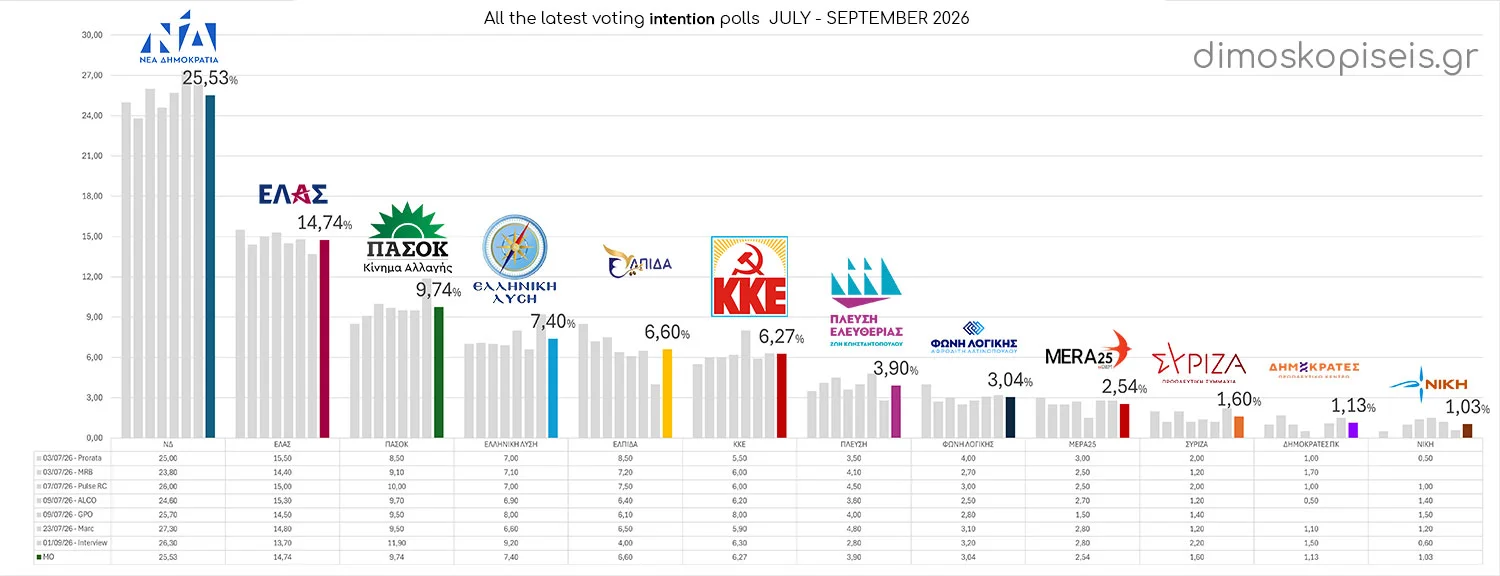
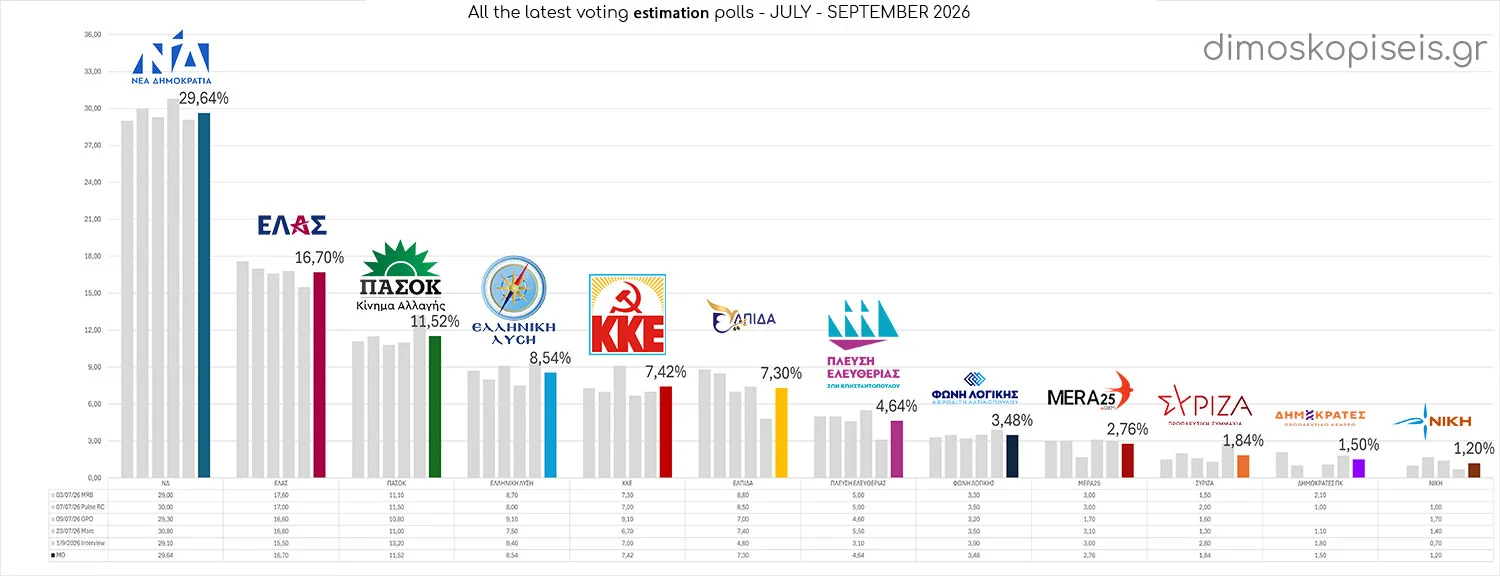
Polls until May 2026
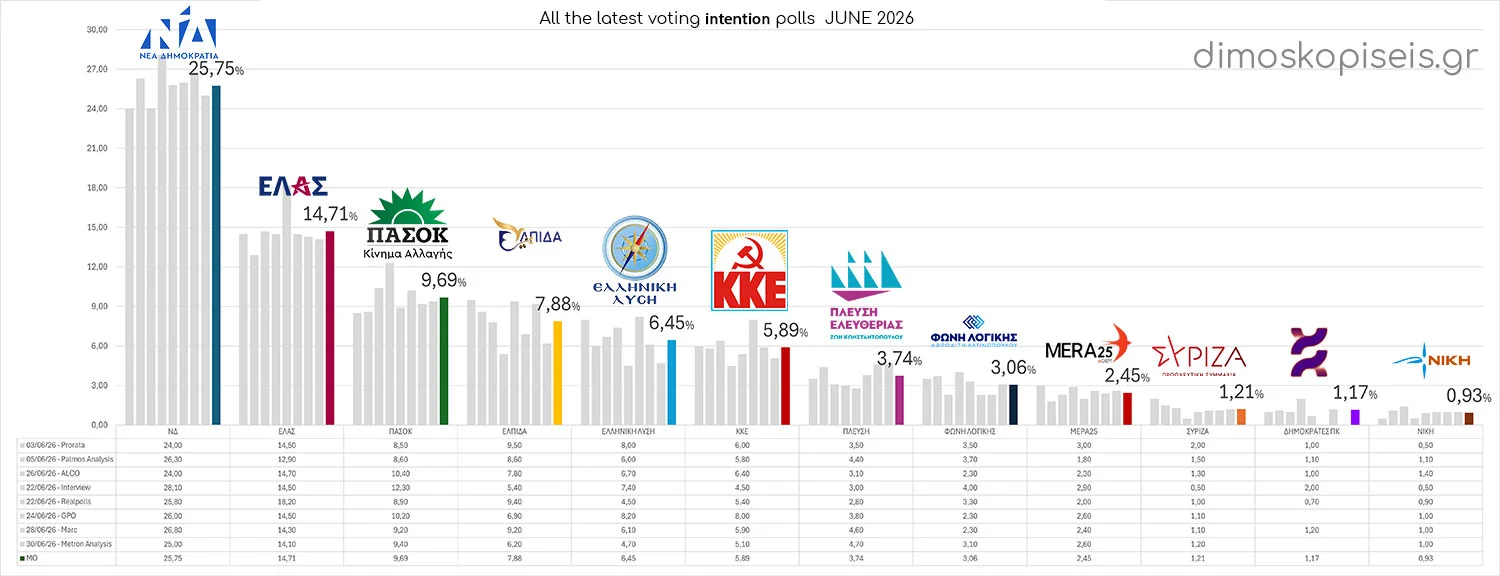
June 2026: The unofficial start of the election period
June 2026 reinforced the feeling that the political system has entered a prolonged election period, despite the fact that there has been no official announcement of elections. The election of Konstantinos Kyranakis as Secretary of New Democracy, the increased political mobility of almost all parties and the intense public debate around post-election scenarios created a climate that is more reminiscent of an election campaign than a normal political period. Despite the Prime Minister’s repeated statements that the elections will be held in the spring of 2027, intense speculation developed during June about a possible resort to the polls after the Thessaloniki International Fair — an assessment that dimoskopiseis.gr does not share based on current data.
Accuracy and the increased cost of living remained the most important social and political issue, continuing to be the main field of confrontation between the government and the opposition. At the same time, developments in the center-left, the ongoing weakening of SYRIZA and the movement of cadres towards the Greek Left Coalition (EL.A.S.) continued to alter the balance of the political system.
The winners and losers of June
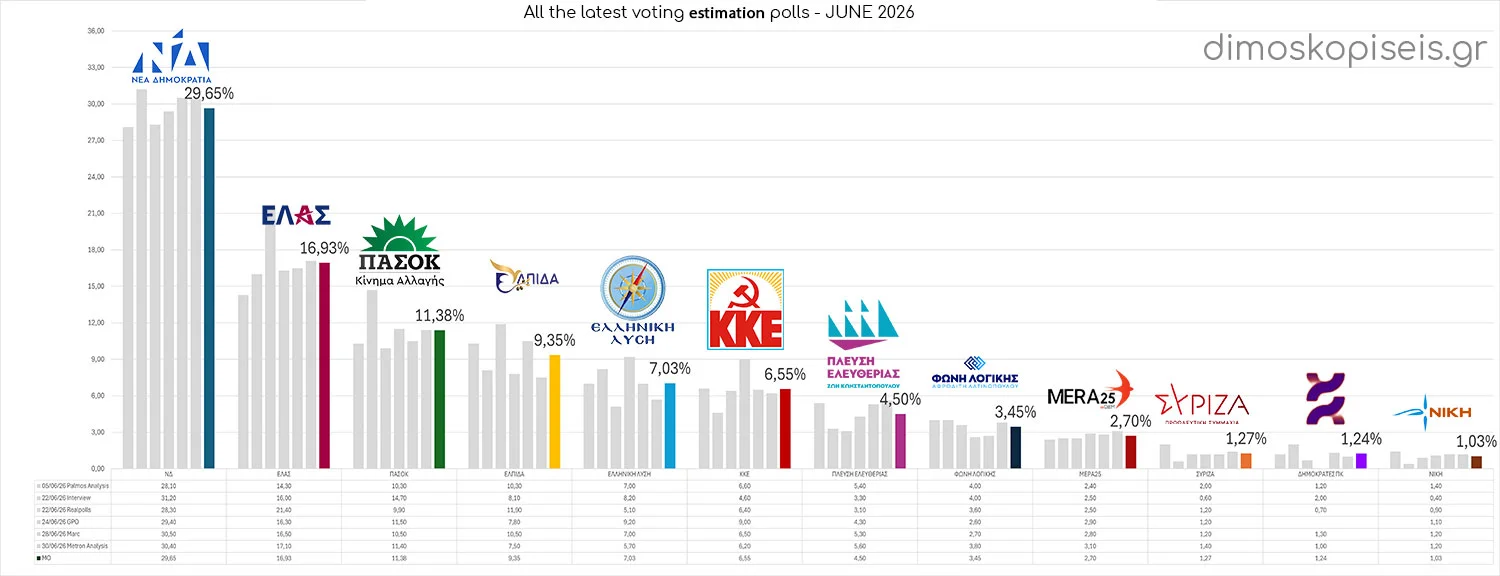
The two new political formations continued to dominate the polls in June. The Greek Left Coalition (EL.A.S.) recorded a significant increase in its percentages, increasing its poll influence by 1.51 percentage points (+11.44%) compared to May and consolidating its position as the main opposition pole. New Democracy showed a slight increase or stabilization of its percentages, while PASOK recorded a marginal decline.
On the other hand, Hope for Democracy showed the largest drop among the new parties, losing 1.8 percentage points (-19.6%), which suggests that the initial momentum of its entry into the political scene is beginning to be reassessed by part of the electorate. On the contrary, Hellenic Solution recovered a large part of the losses it had recorded in May, recording an increase of 1.07 percentage points (+19.89%), while KKE and MeRA25 showed a smaller upward trend.
The downward trend continued for the smaller parties, with SYRIZA now almost definitively removed from the possibility of parliamentary representation and NIKI recording historically low performances, raising for the first time a question of political survival.
The new balance of power
The June polls now form a clear dipole between New Democracy and the Greek Left Alliance, which, based on current data, may become the main feature of the political confrontation until the 2027 elections.
PASOK seems to be consolidating third place, mainly due to the decline of Hope for Democracy and not due to any particularly strong upward momentum in its own percentages.
A second group of parties follows that, based on current data, appear to be securing their parliamentary presence with relative ease. This includes Hope for Democracy, Hellenic Solution, which surpassed the KKE thanks to the rise it recorded in June, the KKE and Pleusi Eleftherias.
The last category now includes five parties with uncertain prospects. Voice of Reason and MeRA25 are moving on the limits of parliamentary representation, while SYRIZA, Democrats – Progressive Center and NIKI are recording percentages that call into question even their long-term political survival. Particularly impressive is the decline of NIKI, which now occupies the last place in the ranking, while SYRIZA continues to record percentages of political annihilation.
Hypothetical distribution of seats
Based on the average of opinion polls after the reduction of undecideds in June 2026, a scenario of an eight-party Parliament emerges again, which does not allow the formation of an independent government and leaves open only extremely difficult scenarios of government collaborations.
New Democracy occupies approximately 119 seats (-1 compared to May), E.L.A.S. 52 seats (+5), PASOK remains at 35 seats, while Hope for Democracy falls to 28 seats, losing seven compared to the previous month. This is followed by Hellenic Solution with 21 seats (+2), KKE with 20 seats, Pleusi Eleftherias with 14 seats and Foni Logikis with 11 seats (+1).
The numerical data of the month
June 2026 was one of the most productive months in the history of Greek opinion polls. We recorded a total of 13 voting intention polls from 8 different companies, while the monthly average was calculated using the 9 most recent measurements from each company.
Correspondingly, in the polls after the reduction of undecideds, 9 surveys were recorded from 6 different companies. Of particular interest was the reappearance of companies without a regular monthly presence, such as Palmos Analysis, which had not published a political measurement since December 2025, as well as Prorata, whose previous political measurement had been published in April 2026.
New Democracy is a liberal-conservative political party in Greece. In contemporary Greek politics, New Democracy has been the main centre-right to right wing political party and one of the two major parties.
EP affiliation: EPP
PARLIAMENTARY ELECTIONS 2023: 40.56% 158 SEATS
EURO ELECTIONS 2024: 28.31% 7 SEATS
CURRENT STRENGTH: 155 Parliamentary Seats (Government)
New Democracy LATEST POLLS
New Democracy maintains its poll dominance in June 2026, remaining consistently at high levels and displaying remarkable resilience in the face of the significant fluidity that characterizes the political scene. Despite maintaining its lead by a large margin over the second party, there are currently no signs of further growth that could create realistic conditions for achieving parliamentary autonomy in the next national elections.
The average of the polls after deducting undecided voters stands at 29.65%, exactly the same level as in May 2026, confirming the stabilization of the electoral influence of the ruling party. This percentage remains increased by +1.34 percentage points compared to the 2024 European elections, but still falls short of the result of the 2023 national elections by -10.91 points.
The next political period is of particular interest, as the start of the Prime Minister’s tours and political rallies, combined with the announcements of the Thessaloniki International Fair, may affect the rallying of New Democracy voters. At the same time, a significant factor of uncertainty remains the possibility of the establishment of a new political entity by Antonis Samaras, as such a development could put pressure on the right wing of the party’s electoral base and make it even more difficult to achieve parliamentary autonomy.
Given current data, New Democracy seems to have secured the position of the first party in the next elections. The crucial question for the coming months is no longer whether it will maintain its lead, but whether it will be able to expand its electoral influence to a degree that will allow it to once again claim the independent governance of the country.
JUNE 2026
The Greek Left Alliance (EL.A.S.) is a Greek political party, founded on 28 May 2026 by former Prime Minister Alexis Tsipras. The party defines itself as the “governing left”, stating that it expresses the three historical currents of the left: social democracy, radical left and political ecology.
EP affiliation: ?
New party
CURRENT STRENGTH: 0 Parliamentary Seats
EL.A.S. LATEST POLLS
The Greek Left Alliance (EL.A.S.) emerged as the big winner in the June 2026 polls, confirming that the dynamic performance it recorded during its first month of presence was not a cyclical phenomenon. As former Prime Minister Alexis Tsipras pointed out, poll trends now place ELA in the role of the main opposition and, under certain conditions, in a position to even claim political primacy in the medium-term future.
EL.A.S. recorded the largest increase among all parties in absolute percentage points compared to May, reaching an average of 16.93% in the polls after accounting for undecided voters. This performance reduces the gap with New Democracy to 12.72 percentage points, forming for the first time in several years a relatively stable duopoly at the top of the political system. Of particular interest is the fact that in individual polls, such as that of Real Polls, the distance between the two parties was even limited to a single digit percentage, an element that fueled the discussion about the formation of a new political competition.
The continued strengthening of EL.A.S. seems to be due both to the rallying of a large part of the broader progressive space and to the search by voters for a new, but at the same time politically experienced, alternative proposal for power. In contrast to other newly established parties, E.L.A.S. has the advantage of the recognition of its founder and the experience of governance, which allows it to claim a leading role from the outset.
The next period is expected to be decisive for the future course of the party. Of particular interest is the composition of the cadres that will frame E.L.A.S., the formation of its electoral lists, as well as the presentation of a comprehensive political and governmental program. These elements will largely determine whether the current poll dynamics can be consolidated and develop into a real electoral threat for New Democracy or whether E.L.A.S. will ultimately be limited to the role of the strong main opposition.
Given today’s circumstances, E.L.A.S. is no longer simply claiming second place in the political system. For the first time since its foundation, the question arises whether it can develop into the main rival pole of power in the next electoral period.
JUNE 2026
The Panhellenic Socialist Movement, known mostly by its acronym PASOK, is a social-democratic political party in Greece. Until 2012 it was one of the two major parties in the country. After a decade of poor electoral outcomes, PASOK has retained its position as one of the main Greek political parties and is currently the second largest party in the Greek Parliament.
EP affiliation: S&D
PARLIAMENTARY ELECTIONS 2023: 11.84% 31 SEATS
EURO ELECTIONS 2024: 12.79% 3 SEATS
CURRENT STRENGTH: 33 Parliamentary Seats (Official Opposition)
PASOK LATEST POLLS
PASOK shows clear signs of stabilization in the polls in June 2026, halting the sharp downward trend that had been recorded the previous month after the emergence of new political formations. Despite the significant strengthening of the Greek Left Alliance (EL.A.S), the poll data show that the mass movements of voters from PASOK to Alexis Tsipras’ party seem to have been, at least temporarily, limited.
The retreat of Hope for Democracy allows PASOK to re-establish third place in the political system, without facing a direct threat from the parties that follow. At the same time, however, the significant difference that now separates it from EL.AS. does not allow it, under current conditions, to directly claim the role of the main opposition or to challenge the new balance of power in the center-left space.
The average of the polls after deducting undecided voters stands at 11.38%, showing a marginal improvement compared to May 2026. Despite this stabilization, the party’s performance remains lower by -0.46 percentage points than the result of the 2023 national elections and by -1.41 points compared to the 2024 European elections, confirming that PASOK continues to move below the levels of the last two electoral contests.
The greatest political interest for the coming months concerns the strategic choice that the party leadership will follow. PASOK is called upon to decide whether to continue to focus the political confrontation mainly against New Democracy, claiming the role of the main alternative government proposal, or whether to turn more towards E.L.A.S., attempting to regain second place in the opposition space.
This choice may prove decisive not only for PASOK’s poll performance, but also for the overall balance of power in the political system until the 2027 elections. Given current conditions, PASOK seems to have secured the role of one of the main political players, but the question remains whether it will be able to return to the claim to power or whether it will be limited to the role of a necessary partner in future scenarios of government collaborations.
JUNE 2026

Hope for Democracy is a political movement in Greece, founded by pediatrician Maria Karystianou. The movement presents itself as multidisciplinary with its main axes being the demand for justice and anti-corruption.
EP affiliation: ?
New party
CURRENT STRENGTH: 0 Parliamentary Seats
Hope for Democracy LATEST POLLS
Hope for Democracy, after its impressive entry into the political scene in May 2026, recorded the first corrective trends in its poll ratings in June. This decline leads Maria Karystianou’s party into an initial phase of stabilization, currently forming a clear picture of ranking in fourth place in the political system.
Despite recording the largest drop among all parties, with losses of 1.8 percentage points compared to May, Hope for Democracy still maintains a significant distance from the other parties in the middle class of influence. Given current data, it remains the strongest party in the group claiming positions 4 to 7, which appear to ensure parliamentary representation with relative ease in the next elections.
This development cannot necessarily be considered negative, as it is common for newly established political parties to record particularly high performances during their first period of emergence, followed by a phase of normalization and redefinition of their electoral influence. The crucial question for Hope for Democracy is not so much the temporary decline in its percentages, but the level at which it will manage to stabilize in the coming months.
Of particular interest is the fact that the party is still in a phase of political formation. Its staffing, the formation of its electoral lists and the gradual publication of its political positions are expected to have a decisive influence on its future course. The clearer picture that voters will gain of its ideological and programmatic stance may either strengthen its momentum again or lead to a further readjustment of its percentages.
The key political question for the coming period is whether Hope for Democracy will be able to regain the momentum that allowed it to claim even third place during its first month of presence or whether it will ultimately focus on maintaining its leading position among the middle-influence parties. In any case, its course remains one of the most important and unpredictable factors in the new political landscape that is taking shape in view of the 2027 elections.
JUNE 2026
The Communist Party of Greece is a Marxist–Leninist political party in Greece. It was founded in 1918 as the Socialist Workers’ Party of Greece (SEKE) and adopted its current name in November 1924. It is the oldest political party in modern Greek politics.
EP affiliation: NI
PARLIAMENTARY ELECTIONS 2023: 7.69% 21 SEATS
EURO ELECTIONS 2024: 9.25% 2 SEATS
CURRENT STRENGTH: 21 Parliamentary Seats (4th party)
KKE LATEST POLLS
In June 2026, the KKE maintains the image of poll stability that has characterized it over time, without, however, showing clear signs of recovering the losses it recorded after the emergence of the Greek Left Coalition (EL.A.S.). The party continues to move at levels lower than those it had recorded during the particularly successful 2023–2024 electoral period, both in voting intention and in polls after the reduction of undecided voters.
The average of the polls after reduction is 6.55%, which is the second lowest performance of the party since the 2023 national elections. This figure is down by -2.70 percentage points compared to the 2024 European elections and by -1.14 points compared to the 2023 parliamentary elections.
Despite the relative decline, the KKE continues to be one of the most stable parties in the political system, maintaining a strong and coherent electoral base. The last two polls in May and June may reflect the real “hard core” of its electoral influence, which limits the possibility of further significant losses in the near future.
The main question for the coming months is not so much whether the KKE will maintain its parliamentary power — something that is considered almost certain by today’s standards — but whether it will be able to regain some of the momentum it had developed during the period 2023–2024. This development will depend to a large extent on the stabilization of the new political scene and on whether E.L.A.S. will maintain its increased influence in the wider Left.
JUNE 2026

The Greek Solution is a political party in Greece founded by Kyriakos Velopoulos. The party is right-wing to far-right and has been described as ideologically ultranationalist, national conservative.
EP affiliation: ECR
PARLIAMENTARY ELECTIONS 2023: 4.44% 12 SEATS
EURO ELECTIONS 2024: 9.25% 2 SEATS
CURRENT STRENGTH: 11 Parliamentary Seats (5th party)
Greek Solution LATEST POLLS
Hellenic Solution and Kyriakos Velopoulos emerged as major winners in the June 2026 polls, following the intense pressure the party had faced in the previous month due to the emergence of new political formations. The June polls show that much of the losses of May have been recovered, allowing Hellenic Solution to return to levels that once again make it one of the main players in the middle-class parties.
The average of the polls after deducting undecided parties is 7.03%, recording a significant improvement compared to May. Despite this recovery, the percentage remains reduced by -2.27 percentage points compared to the 2024 European elections, while it is still significantly higher, by +2.59 points, than the result of the 2023 national elections.
This development confirms that the Hellenic Solution continues to have a strong and relatively stable electoral base, which allows it not only to ensure its parliamentary presence, but also to claim increased parliamentary representation compared to the current composition of the Parliament. At the same time, the recovery in June suggests that some of the voters who had temporarily turned towards new political options seem to be reconsidering their initial choices.
It is worth noting that the poll performance of the Hellenic Solution appears to be largely influenced by the broader reshuffles in the area of right-wing and anti-systemic voting. The rise or fall of other parties in the same political space seems to directly affect its percentages, making it one of the parties most sensitive to political changes.
JUNE 2026

Course of Freedom is a Greek left-wing political party founded in 2016 by the former President of the Hellenic Parliament, Zoe Konstantopoulou.
EP affiliation: NI
PARLIAMENTARY ELECTIONS 2023: 3.17% 8 SEATS
EURO ELECTIONS 2024: 3.40% 1 SEAT
CURRENT STRENGTH: 8 Parliamentary Seats (8th party)
Course of Freedom LATEST POLLS
June 2026 marks the first month since February 2026 in which the Freedom Movement has not recorded a new decline in the polls, showing trends of stabilization at the levels it was moving in the fall of 2024. This development may mark the completion of an intense cycle of rise and fall, during which the party reached rates approaching 13% in the polls after the reduction of undecided voters, before returning to levels that likely reflect its stable electoral core.
The course of Freedom Movement over the last two years is one of the most characteristic cases of high poll volatility in the Greek political system. From a small parliamentary party, it temporarily evolved into a main contender for second place, only to then return to lower, but now more stable levels of electoral influence.
The average of the polls after deducting undecided voters stands at 4.50% in June, a percentage increased by +1.10 percentage points compared to the 2024 European elections and by +1.33 points compared to the 2023 national elections. Despite the significant decline from the high levels it had recorded in the previous period, Pleusi Eleftherias now seems to have consolidated its presence in the political system, with no immediate risk of losing its parliamentary representation.
However, the great volatility that the party has shown in recent years makes it particularly difficult to predict its future course. The main question for the coming months is whether Pleusi Eleftherias will be able to regain some of the momentum that allowed it to record double-digit percentages or whether it will stabilize definitively at levels close to the current average.
The answer to this question seems to depend to a significant extent on the movements of voters between Plevsis Eleftherias, the Greek Left Alliance (EL.A.S.) and Hope for Democracy, as well as on the overall formation of the new political map of the opposition. For the time being, however, Plevsis Eleftherias continues to be a stable parliamentary factor, even if it is significantly far from the poll highs it recorded in the first half of 2026.
JUNE 2026

The Voice of Reason is a far-right ultranationalist political party in Greece. It was established in 2023 by Afroditi Latinopoulou, a lawyer and a Member of the European Parliamen.
EP affiliation: PfE
PARLIAMENTARY ELECTIONS 2023: 0.43% 0 SEATS
EURO ELECTIONS 2024: 3.04% 1 SEAT
Voice of Reason LATEST POLLS
The Voice of Reason continues to be one of the most stable surprises on the Greek political scene, maintaining for many consecutive months percentages that allow it to claim its parliamentary presence with claims. This stability is reflected not only in opinion polls after the reduction of undecideds, but also in voting intention, where in June 2026 it recorded 3.06%, a percentage that confirms the existence of a coherent electoral base.
Despite this stability, the Voice of Reason continues to be the last party that, given the current data, shows clear possibilities of parliamentary representation. This position makes it particularly vulnerable to possible voter movements that may be caused by the political developments of the coming months, as even small changes in its percentages could prove decisive.
The average of the polls after the reduction of undecided voters is 3.45% in June, exactly the same level as in May 2026. This performance remains increased by +0.35 percentage points compared to the 2024 European elections and by +3.02 points compared to the 2023 national elections, confirming that the party has managed to establish an electoral presence that is clearly stronger than the one it had during the previous electoral period.
As for several other parties in the current political climate, the future poll course of the Voice of Reason remains difficult to predict with certainty. The most important factor of uncertainty seems to be the possibility of establishing a new political entity under Antonis Samaras, as such an undertaking could address a segment of the same political and electoral audience.
The main question for the coming months is whether the Voice of Reason will manage to maintain the remarkable stability it has shown to date or whether developments in the right-wing and conservative factions will exert pressures that will remove it from the zone of parliamentary representation. For now, however, the party is still in the electoral game and maintains realistic chances of presence in the next Parliament.
JUNE 2026

The European Realistic Disobedience Front, or MeRA25 (Greek: ΜέΡΑ25), is a left-wing Greek political party founded in 2018. Its founder and General Secretary is former Syriza MP and Finance Minister Yanis Varoufakis.
PARLIAMENTARY ELECTIONS 2023: 2.50% 0 SEATS
EURO ELECTIONS 2024: 2.54% 0 SEATS
MeRA25 LATEST POLLS
MeRA25 is among the parties that managed to reverse the downward trend recorded in May 2026, presenting a mild but notable recovery. Although the rise in June is not enough to fully recover the losses caused by the recent political reshuffles, it confirms that the party still has a solid electoral base and keeps alive the prospects of parliamentary representation.
The average of the polls after the reduction of undecided voters is 2.70%, a percentage increased by +0.16 percentage points compared to the 2024 European elections and by +0.20 points compared to the 2023 national elections. Although the difference from the critical threshold of 3% remains small, the fact that the party has been moving for a long time close to electable percentages keeps the possibility of its return to Parliament open.
Unlike other small parties that show intense volatility, MeRA25 has demonstrated remarkable poll resilience in recent years, managing to remain consistently close to parliamentary representation even in periods of major political reshuffles. This stability strengthens the scenario of its participation in a possible nine-party Parliament, if the electoral conditions prove favorable.
The key question for the coming months is whether the small upward trend in June marks the beginning of a substantial return of the party to electoral percentages or whether the losses it recorded after the rearrangement of the political scene will prove to be largely permanent. The course of the new political formations, developments in the wider Left and the ability of MeRA25 to regroup its electoral audience will largely determine its final position in view of the 2027 elections.
As things stand, MeRA25 remains the small party with the most realistic chances of exceeding the parliamentary representation threshold, which makes its poll performance one of the most interesting indicators of the next election period.
JUNE 2026

The Democrats Progressive Center (formerly Movement of Democracy) is a political party in Greece, founded on November 23, 2024 by Stefanos Kasselakis. It places itself in the area of the “modern center-left” and progressivism.
CURRENT STRENGTH: 5 Parliamentary Seats (9th party)
Democrats Progressive Center LATEST POLLS
The Democrats – Progressive Center of Stefanos Kasselakis opens the category of parties that, based on current polling data, do not show realistic prospects for parliamentary representation in the next national elections.
The Democrats – Progressive Center of Stefanos Kasselakis continue their downward trend in the polls in June 2026, completing four consecutive months of decline. Despite the intense political activity of the leadership, the tours throughout Greece and the continuous public presence of the party, the polls record new historically low levels of electoral influence.
The average of the polls after deducting undecided voters is only 1.24%, a performance that significantly distances the party from the threshold for parliamentary representation and does not allow, with current data, the formulation of realistic expectations for entry into the next Parliament.
The ongoing reshuffle of the political scene in the center-left space, the emergence of new political formations and the strengthening of E.L.A.S. have created a particularly competitive environment for the Democrats – Progressive Center. The party seems to be struggling to shape a distinct political brand that would allow it to effectively claim a part of the electorate that is seeking alternative political options.
Despite the unfavorable opinion poll picture, the intense political activity of Stefanos Kasselakis, his personal recognition and the possible future reshuffles in the center-left space maintain a limited but real margin for political recovery. However, for the prospect of a return to electable percentages to become realistic, not only a voter turnabout but also a substantial political restructuring of the party will be required.
Given today’s circumstances, the main question for the Democrats – Progressive Center is no longer whether they can immediately claim parliamentary representation, but whether they will manage to halt the continuous decline in the polls and reposition themselves with claims in the space of the Greek center-left that is undergoing restructuring.
JUNE 2026

The Coalition of the Radical Left – Progressive Alliance, best known by the syllabic abbreviation SYRIZA, is a centre-left to left-wing political party in Greece. It was founded in 2004 as a political coalition of left-wing and radical left parties, and registered as a political party in 2012.
EP affiliation: Left – GUE/NGL
PARLIAMENTARY ELECTIONS 2023: 17.83% 47 SEATS
EURO ELECTIONS 2024: 14.92% 4 SEATS
CURRENT STRENGTH: 26 Parliamentary Seats (3th party)
SYRIZA LATEST POLLS
The particularly unfavorable poll picture presented by SYRIZA in May 2026 deteriorated even further in June, confirming that the party is going through the deepest political and electoral crisis in its history. Polls now show that SYRIZA is stabilizing at percentages that do not allow for any realistic expectation of parliamentary representation, at a time when the current leadership has already announced the party’s non-participation in the next national elections.
Although the numerical changes now have more historical and analytical than political significance, we must record that the average of the polls after deducting undecided voters has fallen further and stands at just 1.27%. This percentage is far from the 3% threshold required to enter Parliament and is reduced by -13.65 percentage points compared to the 2024 European elections and by -16.56 points compared to the 2023 national elections. This is one of the largest electoral and opinion poll collapses recorded for a major political party in post-democratic Greece.
SYRIZA’s opinion poll shrinkage reflects not only the shift of a large part of its electoral base towards new political formations, but also the deep crisis of political representation faced by the space that governed the country in the period 2015–2019. The emergence of the Greek Left Coalition as a key pillar of the broader left and progressive faction seems to have further accelerated the process of weakening the now historic party of the main opposition of the previous decade.
The questions raised about the future of SYRIZA are now more existential than electoral. The decisions that will be taken by the party bodies, the possibility of a change of leadership and the strategy that will be chosen for the next day will determine not only the future of the party but also its very existence as an autonomous political entity.
At the same time, a methodological question arises for polling companies and analysts: to what extent does it make sense to continue the systematic polling of a party that has announced that it does not intend to participate in the next elections. On the other hand, a possible change of leadership or a revision of the strategic participation could bring SYRIZA back into the political game, raising once again the question of whether the party still has the political and social forces required to claim its return to the next Parliament.
Given today’s circumstances, however, SYRIZA is no longer faced with the question of its electoral percentage, but with the much more fundamental question of its political survival.
JUNE 2026
The Democratic Patriotic Movement – Victory “NIKI” often shortened to simply Niki (Victory), is a right, far-right political party in Greece. It was founded by educator Dimitris Natsios in 2019.
EP affiliation: NI
PARLIAMENTARY ELECTIONS 2023: 3.70% 10 SEATS
EURO ELECTIONS 2024: 4.37% 1 SEAT
CURRENT STRENGTH: 9 Parliamentary Seats (7th party)
NIKH LATEST POLLS
NIKI continues to be one of the parties most affected by the recent political upheavals, recording a further deterioration in its poll image in June 2026. For the fourth consecutive month, it has been on a downward trend, as a result of which it has now stabilized in the last place in the ranking of parties systematically monitored by dimoskopiseis.gr.
The average of the polls after deducting undecided voters is only 1.03%, which is the lowest performance of NIKI since its entry into Parliament. This recording is reduced by -3.34 percentage points compared to the 2024 European elections and by -2.67 points compared to the 2023 national elections, recording one of the largest poll declines that have occurred in the last year.
The continuous weakening of NIKI seems to be directly linked to the rearrangement of the political space in which it operates, as the emergence of Hope for Democracy seems to have absorbed a significant part of its electoral base. At the same time, the general rearrangement of the political scene has significantly limited the party’s ability to maintain the poll momentum it displayed during the period 2023–2024.
Given that NIKI has had to register electable percentages for about a year, since June 2025, the prospect of its return to levels of parliamentary representation currently appears particularly difficult. The possibility of the establishment of a new political entity under Antonis Samaras, combined with the maintenance of Hope for Democracy’s influence, creates additional pressure on an already limited electoral audience.
The main question for NIKI is no longer so much about its immediate return to electoral percentages, but rather its ability to maintain a distinct political presence and prevent the further shrinkage of its electoral influence. Given the current situation, the party is faced with the most difficult political situation since its founding and is called upon to redefine its position and role in the new political landscape that is taking shape in view of the 2027 elections.
 Κάντε το dimoskopiseis.gr -το ανεξάρτητο site-